Tuesday, July 24, 2012

Review: The Prisoner of Heaven by Carlos Ruiz Zafón

During Christmastime 1957 in Barcelona, Spain, bookseller Daniel Sempere is minding his father’s shop, hoping sales will improve. Otherwise, things are good. He and his wife, Bea, have a baby boy named Julián, and their close friend Fermín Romero de Torres is about to finally give up bachelorhood and marry his beloved Bernarda. But then a mysterious stranger visits the shop looking for Fermín. Already worried about his impending nuptials, Fermín is terribly shaken, and Daniel is determined to find out why.

Thus the action is set in motion in The Prisoner of Heaven, the third book in the Cemetery of Forgotten Books cycle by Carlos Ruiz Zafón. Taking place after the action of The Shadow of the Wind and incorporating The Angel’s Game, The Prisoner of Heaven evokes the same gothic atmosphere of Spain during the first half of the 20th century. And once again, Zafón’s storytelling draws the reader into this complex world and creates a plot with pain-turning drive. We find out about Fermín’s time in prison and his connection to the Semperes. David Martin, the protagonist of The Angel’s Game, plays a significant role, and Zafón connects the three books in satisfying ways while adding a new narrative thread that will undoubtedly be featured in the next book in the cycle.

While I greatly enjoyed The Prisoner of Heaven, I found myself wishing I remembered the earlier books better. I re-read the book jackets and did some Internet searching looking for plot details I sort of remembered, both of which I found frustrating. (Those Internet folks did a good job of not revealing spoilers!) I wish had the time to read all three close together; I have a feeling I would be very pleased with how they fit with each other.

But then I would be even more anxious for the story to continue. If you enjoyed Zafón’s previous books in the cycle, it’s a sure bet you’re going to enjoy this one as well.

Sunday, July 08, 2012

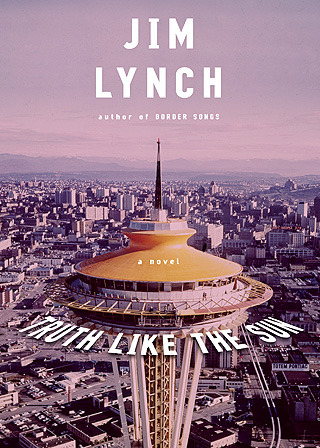
Book review: Truth Like the Sun by Jim Lynch

Elvis Presley once said, “Truth is the like the sun. You can shut it out for a time, but it ain't going away.” Elvis repeats the line when he visits the 1962 Seattle World’s Fair in Jim Lynch’s third novel, Truth Like the Sun.

The story focuses on golden boy and “father of the fair” Roger Morgan and features many cameos from the real celebrities of the time. The story opens as the fair opens, with Morgan showing off the Space Needle—which in this fictional telling was his idea—and moves back and forth in time to 40 years later when Morgan, now in his 70s, has finally decided to run for mayor. He shares this part of the narrative with Helen Gulanos, a journalist and single mother new to Seattle looking to catch a big story.

Catch one she does during the run up to the election. Helen works for the Seattle Post-Intelligencer (often called The P-I), one of the city’s two daily newspapers at a time when newspaper sales have dropped, adding pressure to beat rival The Seattle Times to the story. (The P-I became the online-only SeattlePI.com, with a drastically reduced staff, in 2009.) Helen happens to be on hand when Roger announces his candidacy and then races to find the truth behind his history.

Truth Like the Sun is a rich and engaging tale, with complex characters and a plot seamlessly interwoven with the history of Seattle. Lynch takes on not only the city’s boom-and-bust history but also the topics of ambition, corruption, the Cold War, and big-time newspaper journalism on the wane. The protagonists are a flawed and likeable pair that grudgingly admire each other, and the truth turns out to be elusive, often obscured by the clouds of memory and the need to sell newspapers. Anyone interested in the city of Seattle, political intrigue stories, or just plain good writing should enjoy this book.

Article first published as Book review: Truth Like the Sun by Jim Lynch on Blogcritics.

Wednesday, July 04, 2012

Review: What Dies in Summer by Tom Wright

Jim is a teenager in Texas, living with his grandmother. One morning in February, his cousin Lee Ann, whom he calls L.A., shows up on the porch shivering and refusing to speak. She moves in with Jim and Gram and starts seeing a therapist. JIm, being fond of L.A., is fine with this. He and L.A. are friends, and he has his own peculiarities, like having a touch of the Sight.

The school year comes to an end without incident, but the same cannot be said for summer, which is marked by danger and death. Jim and L.A. find the body of a teenaged girl one day, and Jim realizes he has been seeing this girl in his dreams for days. Before long her death is linked to the murders of two other girls in the area.

All manner of characters surround Jim and L.A., including a vagrant man with a voice of gold; a homeless woman who seems to know everything about Jim without being told; Jim’s best friend Dee, who loves to paint and whose father likes to hang out with Jim rather than his own son; and Jim’s uncle Cam, L.A.’s father, a part-time musician.

Jim is keen to protect Gram and L.A. and also to explore his relationship with his girlfriend Diana, daughter of a local policeman. When Jim goes on vacation with Diana’s family, the action comes to a head with a full-head of steam and an ending I didn’t see coming.

I loved What Dies in Summer. The writing is rich and evocative, even though the time is only alluded to (early-to-mid 1970’s) and the place rarely mentioned. For the first half of the book, I typically only read one chapter at a time; they were each filling little stories within themselves. I also was often filled with foreboding that made me apprehensive about what was next.

It has plenty of sweet and tender moments as well. Jim befriends one of Gram’s friends as she dies of cancer, and his relationship with Diana is pure teenaged love from a boy’s point of view. Jim is a likable and believable narrator, and his story unfolds at first with languor and then with urgency.

What Dies in Summer is a fine Southern Gothic debut. I’m sure we’ll hear more from the author, psychologist Tom Wright. I will look forward to it.

Article first published as Book Review: What Dies in Summer by Tom Wright on Blogcritics.